

Table of Contents
- Why “just use AI” isn’t a strategy
- What we mean by an AI marketing teammate
- How it’s different from generic AI tools
- The three core pieces: Brand Bots, playbooks, and the execution engine
- What an AI marketing teammate can and can’t do
- How different teams use an AI marketing teammate
- How to decide if one fits your world
- FAQs
AI is everywhere in marketing right now. If you’ve spent any time on LinkedIn or in your inbox, you’ve seen the promises: instant content, magic funnels, “write all your emails with one click.” It’s tempting, especially when you and your team already feel stretched.
If you’ve experimented with generic AI tools—ChatGPT, Jasper, Claude, Gemini—you’ve probably seen both sides. On one hand, they can be brilliant at pulling words together quickly. On the other, when you ask them to “write a landing page” or “create a nurture sequence” without much context, you tend to get something that sounds fine in the abstract but doesn’t really sound like you, doesn’t really know your customers, and doesn’t quite reflect your strategy.
The result is often an uneasy feeling: yes, AI can write, but how do we use it in a way that actually helps the business, fits our brand, and doesn’t confuse or threaten the team?
That’s the question an AI marketing teammate is designed to answer.
Instead of being a random chatbot you occasionally paste prompts into, an AI marketing teammate is a focused system that understands your brand, works the way you work, and helps your team turn strategy into execution—without trying to replace human judgment.
In this article, we’ll unpack what that means, how it differs from generic AI tools, and how small teams, in‑house marketing functions, and agencies can decide if it fits their world.
[Insert short quote here, e.g. from a client: “Ella has become part of the team. We finally use our strategy every day instead of leaving it in slides.”]
Why “just use AI” isn’t a strategy
“Just use AI” is the new “just be on social media.” It sounds sensible, but it doesn’t tell your team anything about how to make good choices.
Without a clear approach, AI usage quickly becomes chaotic. Different people try different tools in different ways. Prompts get saved in personal documents or not at all. Copy gets pasted into decks and docs with no clear source. Some of it is good. Some of it is off‑brand. No‑one can see the whole picture.
Most importantly, generic AI tools don’t know your world. They don’t know:
- Who your best customers are
- How you’re positioned against competitors
- What proof you have and want to lean on
- How your team typically runs a launch, webinar, or nurture
So even when the words they produce are technically okay, you still have to do the work of making sure the messaging is on‑point, the tone is right, and the output fits your funnel.
That’s not wrong, but it’s not the best use of your time. What you really want is for AI to meet you where your strategy already lives and help you carry it through to execution, instead of acting like a clever but forgetful stranger each time.
What we mean by an AI marketing teammate
When we talk about an AI marketing teammate, we mean something quite specific:
A focused AI system that understands your brand, your strategy, and your workflows, and helps your team turn that strategy into clear, consistent marketing assets—without taking over the decisions humans should make.
It’s not a black box that pretends to run your marketing for you. It’s not a generic text generator that you hope will magically sound like your brand. It’s a structured way of:
- Capturing who you serve and how you talk
- Saving your preferred ways of working
- Letting AI do the heavy drafting inside those boundaries
Ella is our version of this: an AI marketing teammate built specifically for small teams—business owners, in‑house marketing groups, and agencies—who need to do more, without diluting what makes them distinct.
[Internal link here to Product: “See how Ella is structured as an AI marketing teammate →”]
How it’s different from generic AI tools
It’s useful to compare this to the tools you might already have open in another browser tab.
It’s important to understand the difference between generic and specialised AI tools.
A generic AI tool is like a very smart stranger at a party. If you give it a very clear brief, it can say surprisingly helpful things. But it doesn’t really know you, your history, or your context. Every conversation starts from almost zero. If you want it to act in a way that fits your brand, you have to feed it a lot of background information every time.
An AI marketing teammate, by contrast, is more like a colleague who’s been properly onboarded. They know what you do, who your customers are, and how you like to show up in the market. They’ve seen examples of your best work. They’ve sat in on your planning sessions. They’re familiar with your standard processes.
In practice, that means:
- When you ask a generic AI tool for help, you’re responsible for “bolting on” your strategy and voice each time.
- When you ask an AI marketing teammate like Ella for help, she’s already holding that context in the background.
They’re both powerful. One is context‑free and flexible. The other is context‑rich and specifically tuned to your marketing world.
Learn why Ella runs as a secure, closed platform →
The three core pieces: Brand Bots, playbooks, and the execution engine
To act like a teammate rather than a toy, Ella is built around three core elements: Brand Bots, playbooks, and an execution engine. Together, they connect your strategy to the work your team actually ships.
Brand Bots: where your brand and clients live
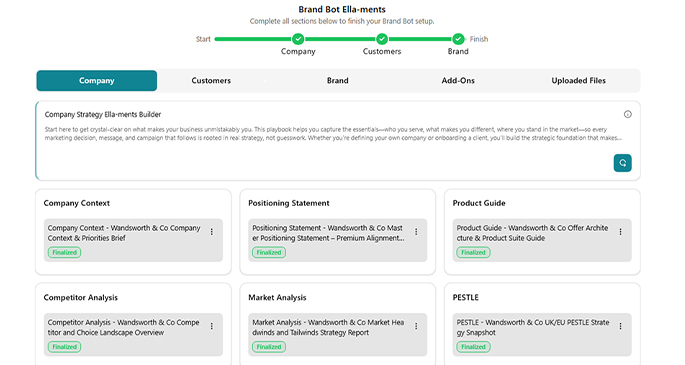
A Brand Bot is a private AI “brain” for each brand or client you work with. It’s where your context lives.
For your own business, you’d teach your Brand Bot things like:
- Who your ideal customers are
- How you describe what you offer and why it matters
- What your tone of voice sounds like
- Which case studies and proof points you lean on most
If you’re a team or an agency, you can have Brand Bots for each brand, business unit, or client.
When you ask Ella to draft an email, write a page, or suggest campaign ideas, she pulls from the right Brand Bot. That keeps everything anchored in your strategy and voice, not whatever happens to come to mind in a generic model.
Each Brand Bot is private to your account. It isn’t shared with other customers and isn’t used to train public models.
Playbooks: your way of working, saved once
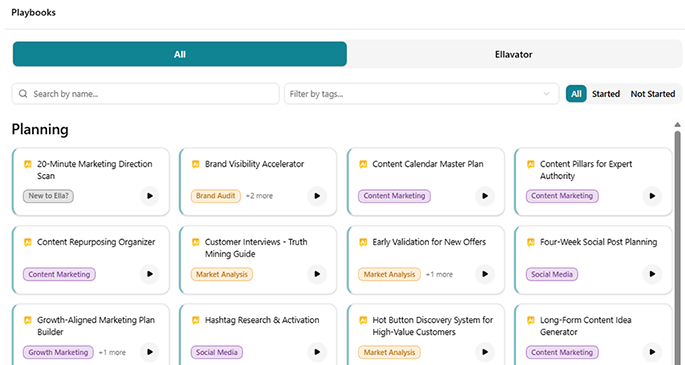
Most good marketers already have patterns in how they work:
- How you usually structure a launch
- The steps you like to follow for a 90‑day plan
- The emails you tend to send for a webinar or lead magnet
Playbooks are where those patterns live.
They don’t have to be complicated. A playbook can simply say:
- Who this initiative is for
- What the goal is
- What assets you usually create
- The rough order in which you create them
Examples might include “product launch,” “welcome and nurture sequence,” “webinar campaign,” or “evergreen lead nurture.”
Saving these into Ella means your team isn’t starting from a blank canvas every time someone says, “We should run a campaign for this.”
Execution engine: from plan to first drafts
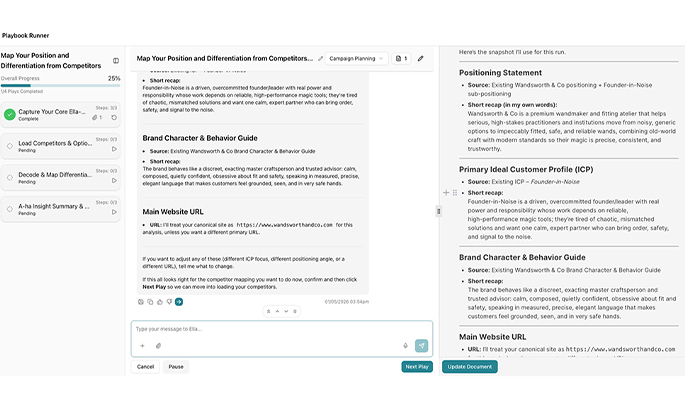
Once you have Brand Bots and playbooks in place, the execution engine is where Ella behaves like a teammate.
You choose a Brand Bot (which brand/client we’re working on) and a playbook (what kind of initiative we’re running). Then you ask Ella to help you produce the pieces in that playbook.
She uses what she knows about the brand—combined with your preferred structure—to draft the assets: pages, emails, posts, scripts. Instead of your team staring at blank docs and fighting the same battles from scratch, they get well‑informed first drafts they can refine.
You still decide what to send, what to publish, and what to change. Ella’s role is to get you to that decision point much faster, while keeping everything aligned.
See the full flow of Brand Bots, playbooks, and execution in Ella →
What an AI marketing teammate can and can’t do
Clear boundaries are important if you want your team to trust this kind of system.
An AI marketing teammate like Ella is very good at doing the kind of work that slows marketing teams down: drafting, redrafting, repurposing, and making sure your core messages and proof points show up consistently everywhere they should. She can help you turn your strategy into a living, breathing set of assets rather than a static slide.
She is not there to decide your business strategy, choose your pricing, or manage client relationships. She doesn’t understand your office politics or the history behind why a particular phrase is sensitive. She also doesn’t “run marketing” on autopilot. You still set priorities, approve work, and decide what’s right for your customers.
In other words:
- You keep ownership of direction, decisions, and relationships.
- Ella helps with the heavy lifting of execution, within that direction.
Used this way, she amplifies your existing strengths instead of competing with them.
How different teams use an AI marketing teammate
The same building blocks—Brand Bots, playbooks, execution—show up differently depending on who you are.
A business owner might use Ella to finally get a simple welcome journey and a regular email rhythm up and running, in their own voice, without hiring a full‑time marketer. Instead of marketing living in their head, that knowledge lives in a Brand Bot that can be used again and again.
A marketing leader of a small in‑house team might use Ella to stop being the human bridge between strategy and execution. They feed their ICPs, positioning, and key messages into Brand Bots and save their go‑to workflows as playbooks. From there, the team can produce campaigns and content in days instead of weeks, without the leader rewriting every piece.
An agency or fractional CMO practice might use Ella to capture their method—how they do positioning, GTM, and 90‑day plans—and then apply that method across multiple clients using Client Brand Bots. That lets more of the team deliver at the level that used to require a partner on every job.
In all cases, the pattern is the same: the team’s thinking gets encoded into the system, and Ella helps them express that thinking more quickly and consistently.
[Internal links:– “Learn how Ella supports business owners →” ()– “See Ella for marketing teams & leaders →” ()– “Explore Ella for agencies & fCMOs →” ()]
How to decide if one fits your world
Not every team is ready for an AI marketing teammate on day one, and that’s okay. A few simple questions can help you decide if now is the right time.
Ask yourself:
- Do we have at least a rough sense of who we serve and what we offer?
- Do we run similar kinds of initiatives more than once (launches, campaigns, webinars, nurtures)?
- Are we regularly slowed down by drafting and revising, rather than by not knowing what to do?
- Would putting our strategy and voice into a shared system make it easier to involve more of the team?
- Are we comfortable keeping humans in the loop, instead of expecting full automation?
If the answer to most of those is yes, then an AI marketing teammate could be the thing that finally connects your strategy work to your day‑to‑day execution in a sustainable way.
If you’re unsure, the safest way to test is small. Choose one area—one journey or one campaign—where marketing currently feels heavier than it should. Use Ella to capture your strategy for that area, build a Brand Bot, define a simple playbook, and let her help you draft the assets. Then decide how, and whether, to expand.
See who Ella is for and how she fits your role →
See how Ella works step‑by‑step →
Ella is a great way to revolutionise the way you work and bring unseen efficiencies to your business. Ella will make your marketing easier, faster and better.
And one final note, there is a difference between using AI and really driving AI. At marketingbots.ai we offer comprehensive onboarding, so that you can get in the driver’s seat from the start and get the results you are after faster than ever before.
Contact us now for more information.
FAQs
Is an AI marketing teammate just a fancy term for an AI copy tool?
No. An AI copy tool is built to generate text from prompts, usually without much context. An AI marketing teammate is built to work inside your marketing system. It remembers your ICPs, positioning, and voice via Brand Bots, uses playbooks that match your workflows, and helps you create assets that line up with your strategy, not just with whatever you happened to type into a prompt.
Do we still need human marketers if we use an AI marketing teammate?
Absolutely. Humans are essential for understanding customers, setting direction, making trade‑offs, and building relationships. Ella’s role is to support them—by making execution lighter, more consistent, and less dependent on a few individuals—not to replace them.
Is our data safe inside an AI marketing teammate like Ella?
Yes. Ella runs as a secure, closed platform. Your Brand Bots and content are private to your account and are not used to train public AI models. You decide who on your team can see and change strategy, and who can simply generate and refine assets.
Read more in our Security & Privacy overview →
Can we start with a single use case before committing fully?
Yes. Many teams start with one specific initiative—a welcome sequence, a new product launch, a webinar, or a 90‑day plan. That lets you see how Ella behaves with real work and real approvals before you roll her out more widely.
How is this different from building our own prompt library?
Prompt libraries can certainly help get more consistent results from generic AI tools, but they still rely on individuals remembering and applying them. An AI marketing teammate goes further by embedding your strategy and workflows into the system itself, so every piece of work starts from the right context automatically, not just from whoever remembered the right prompt.
Author
Stacy Farrell, CEO, MarketingBots.ai